

 App Store

COIN VALUE GUIDES · HALF DOLLAR GUIDES
1937 Walking Liberty Half Dollar Value:Silver, Mint Marks and Proofs
Identify a 1937 Walking Liberty half dollar, separate Philadelphia, Denver, San Francisco and Proof issues and compare silver content with collector value.
 HeriBase Editorial TeamPublished
In this article
Quick answer
A standard 1937 Walking Liberty half dollar contains 90% silver, so an ordinary worn example should not be treated as a modern 50-cent clad coin. Mint mark, wear and original surfaces determine its collector comparison.
For a specific circulated reference, NGC’s Denver guide updated November 18, 2026 lists $20 in Good and $50 in Extremely Fine. These D-mint estimates do not price the Philadelphia issue, the S issue or the separate Proof coin illustrated below.
Coin photos
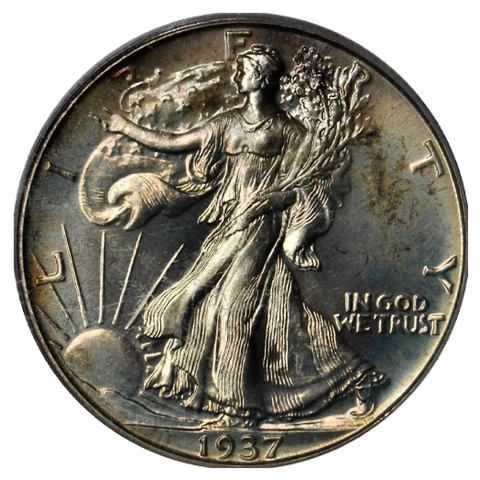
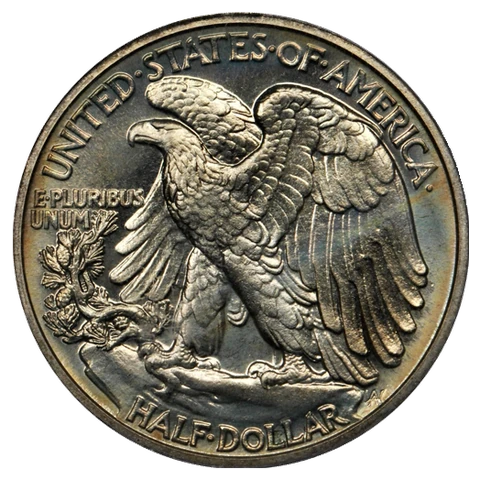
Basics & coin story
Weinman’s Walking Liberty design first appeared in 1916 and remained on circulating half dollars through 1947. Liberty moves toward a rising sun, while the reverse presents a perched eagle. The scene gives the coin its name and explains why a worn 1937 coin remains visually distinct from a later Franklin or Kennedy half.
By 1937 the design was established, not a one-year commemorative. Several U.S. commemorative half dollars also carry 1937 dates, so do not apply this guide merely because a coin says HALF DOLLAR. The full Walking Liberty obverse and eagle reverse must match.
| Feature | What to check |
|---|---|
| Face value | 50 cents |
| Designer | Adolph A. Weinman |
| Composition | 90% silver, 10% copper |
| Nominal mass | 12.50 g |
| Diameter | Approximately 30.6 mm |
| Mint mark location | Reverse near the lower rim |
| Fine silver when full weight | Approximately 0.36169 troy ounce |
For other dates and the broader series, see the Walking Liberty half-dollar guide.
Identification
Confirm the design and date
Find 1937 beneath the walking figure, then check the eagle reverse. A different portrait or commemorative scene belongs to another series. Preserve clear whole-coin images before making close-ups, so identification never depends on an isolated date.
Locate the reverse mint mark
A D or S near the lower reverse identifies a branch mint; no letter identifies Philadelphia. Earlier Walking Liberty mint-mark positions are not a reliable shortcut for a 1937 coin. Read the correct reverse area before selecting a price chart.
Distinguish Proof manufacture from shine
A 1937 Proof is a collector issue separate from the circulation strikes. Mirrored fields can be an important observation, but polishing can also produce reflections. Compare the entire strike and surfaces, preferably with authenticated references, rather than calling any bright coin a Proof.
Condition & value
Amounts are USD. Sources were consulted November 20, 2026; historical guide dates remain attached where applicable. Match mint, finish, numerical grade and any color or strike designation. Retail estimates are not completed sales or guaranteed purchase offers.
| Issue | Grade / condition | Value or reference | Basis | Important condition |
|---|---|---|---|---|
| Normal circulated silver | Correct date and mint | Metal content plus collector component | No universal fixed melt quote | Use current silver spot |
| 1937-D | Good | $20 guide estimate | NGC guide updated Nov. 18, 2026 | Denver only; not a purchase offer |
| 1937-D | Extremely Fine | $50 guide estimate | Same dated NGC guide | Match condition and surface problems |
| Philadelphia / S / Proof | Correct issue and grade | Separate quotation required | Different issue scope | Do not reuse the D values |
Look at Liberty’s head, hand and central drapery along with the eagle’s breast and feathers. Strike weakness and circulation wear can overlap, especially in central detail. Remaining luster and the appearance of the open fields help establish whether softness reflects manufacture, wear or both.
A silver-content calculation uses approximately 0.36169 troy ounce times spot for a standard full-weight coin. That is neither an exact liquidation quote nor a ceiling for a desirable collector coin. Conversely, an elite Proof or MS68 auction record is not a normal price for a heavily worn example.
Use the Walking Liberty series value chart when comparing dates beyond 1937.
Summary
Classify the design, reverse mint mark and finish before estimating the premium. Keep the silver calculation separate from collector comparisons, and preserve original surfaces. For an apparently exceptional coin, a professional grade can be more useful than copying a record price from a search result.
HeriBase is free to download with limited free scans. Optional subscriptions and expert appraisal services are available for an additional fee.
FAQ
Is a 1937 half dollar silver?
A normal Walking Liberty half dollar is 90% silver. Confirm the design because other half-dollar types also use that year.
Where is the mint mark?
On the lower reverse. A D or S identifies a branch mint, while no letter identifies Philadelphia.
Is every shiny 1937 half dollar a Proof?
No. Proof is a method of manufacture; cleaning or polishing can imitate reflectivity.
Should I sell it for 50 cents?
A genuine silver Walking Liberty half should be assessed for its silver and collector components rather than treated as ordinary modern face-value change.