

 App Store

COIN VALUE GUIDES · NICKELS
1930 Buffalo Nickel Value:No Mint Mark, 1930-S and the Letter E
Find what the letter E means on a 1930 Buffalo nickel, where a genuine S mint mark sits, and what to compare when grading a worn coin.
 HeriBase Editorial TeamPublished
In this article
Quick answer
The E on the upper back of a 1930 Buffalo nickel usually belongs to E PLURIBUS UNUM. The mint mark is at the bottom on the reverse, beneath FIVE CENTS. A blank field means Philadelphia. The 1930-S carries an S, and Denver did not issue a standard 1930 Buffalo nickel.
Ordinary worn Philadelphia coins usually trade as common Buffalo nickels. The PCGS guide lists $20 for Philadelphia and $25 for San Francisco in Extremely Fine 40 (XF40). At About Uncirculated 50 (AU50) it lists $30 and $45 respectively.
Coin photos
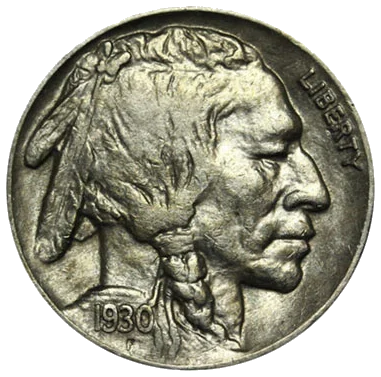
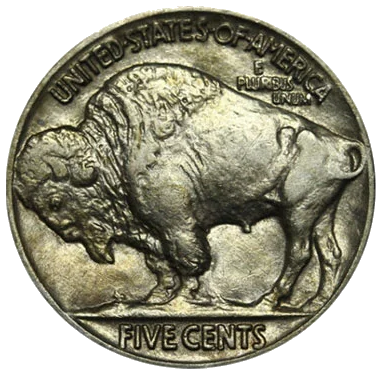
Basics & coin story
James Earle Fraser’s design paired a Native American portrait with a bison. The date on the portrait side and the small reverse mint letter can fade from circulation. The motto sits away from the mint-mark field, so an easier-to-read E does not establish a mint.
The 1930-S had a mintage of 5,435,000. PCGS describes it as conditionally scarce in higher grades. This explains why finished sales for sharp San Francisco coins can diverge from prices for heavily worn pieces. Compare the Buffalo nickel series guide for design and grading context.
| Feature | What to check |
|---|---|
| Normal alloy / mass | 75% copper, 25% nickel / 5.00 g |
| Date | Lower left of portrait side |
| Regular mints | Philadelphia (blank) and San Francisco (S) |
| Reverse motto | E PLURIBUS UNUM, above the bison |
Identification
Read the letter in context
Find FIVE CENTS near the bottom rim. Look immediately below the denomination for the S. The upper reverse E belongs to a word group. A worn part of the motto or a small patch of corrosion should not be treated as a branch-mint letter.
Use the date and reverse together
Check the complete date with sidelight and an uncropped photograph. If the date or mint is unreadable, describe that limitation when comparing sales. Avoid acid restoration and cleaning if original surfaces matter to you.
Separate weak strike from circulation wear
Look at the braid and the bison’s horn, head and shoulder. Design detail can be soft from the strike. Rotate the coin to see whether the luster runs through those areas or breaks where the coin rubbed.
Condition & value
Amounts are in U.S. dollars. Retail guide values are estimates for the stated grade, mint and designation. A dated sale is a record of one coin. Neither is a guaranteed purchase offer.
| Issue | Grade / condition | Value or reference | Basis | Important condition |
|---|---|---|---|---|
| 1930 Philadelphia | Worn, readable date | Common-date market | Compare same-grade sales | A weak date can lower interest |
| 1930 Philadelphia / S | XF40 | $20 / $25 | PCGS retail guide, Nov 2026 | Same grade, two mints |
| 1930 Philadelphia / S | AU50 | $30 / $45 | PCGS retail guide, Nov 2026 | Check mint and original surfaces |
| Letter E visible only | Any | Use the correct mint comparison | Motto diagnostic | No special mint designation |
Summary
Find the date and check below FIVE CENTS. Compare the appropriate mint in the same grade, especially when a clear 1930-S retains original surfaces.
Frequently asked questions
What does E mean on a 1930 Buffalo nickel?
It is normally the first letter of the motto E PLURIBUS UNUM.
Where is the S on a 1930-S nickel?
Look immediately below FIVE CENTS on the reverse.
Was there a 1930-D Buffalo nickel?
No regular Denver issue is listed for 1930.
Is a 1930 nickel without a mint mark rare?
Philadelphia’s regular strike has no mint mark. Well-preserved certified coins trade separately from worn examples.
What affects a 1930-S Buffalo nickel’s value most?
A readable and genuine mint mark, overall condition and original surfaces. Higher grades are harder to find.