

 App Store

COIN VALUE GUIDES · DIMES
1925 Mercury Dime Value:Silver, Mint Marks and Full Bands
Check the silver content and reverse mint mark of a 1925 Mercury dime. Compare no-mint-mark, Denver and San Francisco prices and understand Full Bands.
 HeriBase Editorial TeamUpdated
In this article
Quick answer
A 1925 Mercury dime is 90% silver, with about 0.07234 troy ounce of fine silver at full weight. At Extremely Fine 40 (XF40), the PCGS regular-strike guide lists Philadelphia at $12, Denver at $150 and San Francisco at $100.
A certified Mint State grade and a Full Bands (FB) designation can change the comparison substantially. Check the reverse mark and separation of the bands before using the price of a different mint or designation.
Coin photos
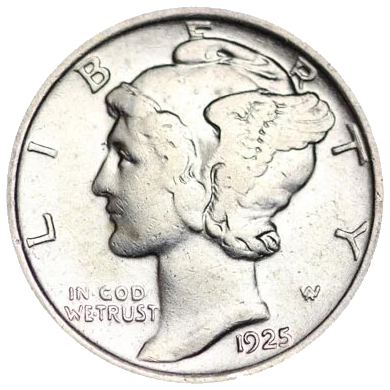
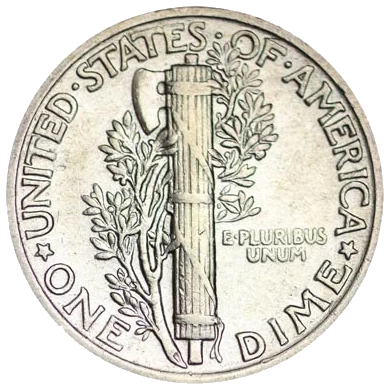
Basics & coin story
The 1925 circulation issues come from Philadelphia, Denver and San Francisco. Guide prices separate sharply by mint. Denver is the more expensive regular issue at XF40 in the cited guide, while a sharply struck San Francisco coin merits comparison within its own Full Bands listings.
The winged cap on Adolph A. Weinman’s portrait gave this dime its familiar “Mercury” nickname. The small AW on the front is the designer’s monogram. The Mercury dime series guide compares other striking years.
| Feature | What to check |
|---|---|
| Alloy | 90% silver, 10% copper |
| Nominal weight | 2.50 g |
| Fine silver | About 0.07234 troy oz |
| Mint mark | At the lower left of the fasces on the reverse |
| Circulation issues | Philadelphia (blank), Denver (D), San Francisco (S) |
Identification
Find the reverse mint mark
Look just to the right of the E in ONE, below the olive branch. On a dark or worn dime, move the light to distinguish an actual raised D or S from residue or a contact mark.
Check wear and the central bands
Some 1925 branch-mint coins have soft centers. Determine whether flattened features share original luster or show distinct rub before choosing a grade. Examine the separation of the center fasces bands under diffuse light.
Price the exact attribution
Use the silver melt value calculator for nominal metal content. Compare actual wear and surface problems before choosing a collector grade. Inspect the central paired bands under magnification and use the FB comparison only when the separation qualifies.
Condition & value
Amounts are in U.S. dollars. Retail guide values are estimates for the stated grade, mint and designation. A dated sale is a record of one coin. Neither is a guaranteed purchase offer.
| Issue | Grade / condition | Value or reference | Basis | Important condition |
|---|---|---|---|---|
| Philadelphia | XF40 / MS65 | $12 / $425 | PCGS Price Guide, checked Nov. 24, 2026 | Regular strike without FB |
| 1925-D | XF40 / MS65 | $150 / $2250 | PCGS Price Guide, checked Nov. 24, 2026 | Regular strike without FB |
| 1925-S | XF40 / MS65 | $100 / $1500 | PCGS Price Guide, checked Nov. 24, 2026 | Regular strike without FB |
| 1925-S | MS65 FB | $3000 | PCGS Price Guide, checked Nov. 24, 2026 | Separate San Francisco Full Bands listing |
| Standard issue | Nominal fine silver | 0.07234 × silver spot | Metal calculation | Before wear and selling costs |
Summary
Read the reverse for mint and grade the coin as found. Compare matching no-FB or FB examples, and check the silver benchmark separately.
Frequently asked questions
Is a 1925 Mercury dime made of silver?
A standard coin is 90% silver and nominally weighs 2.50 grams.
Where is the mint mark on a 1925 dime?
Look at the lower left of the reverse fasces. Philadelphia left the mint-mark field blank.
What does the W-shaped mark mean?
It is the AW monogram of Adolph A. Weinman and does not identify a mint.
Is a 1925-D Mercury dime worth the same as a no-mint-mark coin?
The PCGS guide lists $150 in XF40 for 1925-D compared with $12 for Philadelphia. Both grade and mint matter.