

 App Store

COIN ERRORS & VARIETIES
1776–1976 Half Dollar Errors: Die Caps, Off-Center Strikes and Damage
Check a Bicentennial Kennedy half dollar against documented mint errors and normal double-date, mint-mark and material differences.
 HeriBase Editorial TeamPublished
In this article
Quick answer
The dates 1776–1976 and the Independence Hall reverse are standard Bicentennial features. Look for physical evidence of an abnormal strike, such as a cup-shaped perimeter or a second design impression displaced from the first.
Check both faces and the edge before judging. A normal collector composition or a blank Philadelphia mint-mark position can be part of the expected issue.
Specimen photos
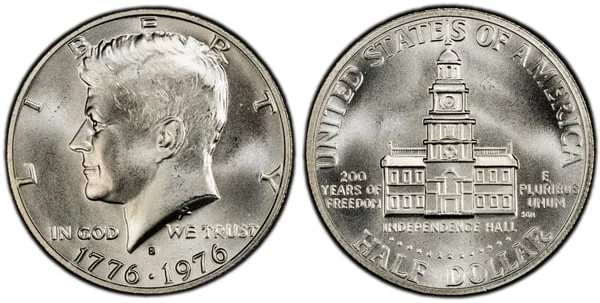
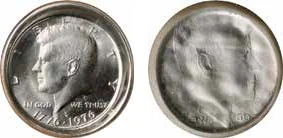
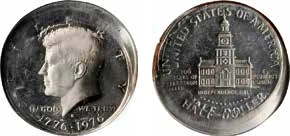
Variety and error comparison
The Bicentennial program temporarily replaced the Kennedy eagle reverse with Independence Hall. The same dual date appears on normal circulation and collector issues, so the design itself cannot distinguish a mint error.
When a struck coin sticks to a die, successive strikes can stretch it into a cap. The cap may also take on an impression from another coin. A double strike leaves two impressions on the same coin, sometimes after the piece shifts relative to the dies.
| Claim | Where to look | Expected evidence | Common lookalike | Next check |
|---|---|---|---|---|
| Obverse die cap | Rim, profile and opposite face | Raised wall or cup with struck detail | Bent coin or squeezed edge | Photograph side profile |
| Double strike with shifted second strike | Both faces | Two coherent design impressions | Shelf-like mechanical doubling | Trace repeated letters and rim |
| Off-center strike | Design boundary | Unstruck crescent and displaced design | Uneven rim wear | Check both faces |
| 1976-S silver doubled die | Obverse lettering | Same doubling pattern as FS-101 | Flat shelf beside lettering | Check the specific silver strike and die reference |
| Silver collector issue | Mint mark, weight and finish | Composition consistent with issued version | Plating or bright surface | Compare the expected issue specifications |
Three identification checks
Read the full date and reverse
Confirm Kennedy and Independence Hall before looking for an error. Use the Bicentennial value guide to identify regular issues and silver collector versions.
Trace the metal and design
A second strike leaves recognizable design elements in positions consistent with two impressions. On a possible cap, check how the wall curves and whether the opposite face contains a related impression.
Check the edge without altering it
Photograph the edge at several positions. Look for abrasion, compressed reeds or tool marks. Compare a normal coin of the same issue before attributing the piece.
Documented cases and value
In the August 19, 2021 Stack’s Bowers auction, lot 6314 was a 1976-D obverse die cap graded NGC MS67. The distorted reverse included an impression from a previously struck coin. Lot 6315 was a 1976-S Proof-63 Cameo that received two strikes outside the collar. Remnants of the first impression remain visible near the edge. Match the production mechanism and the coin’s grade before comparing sale prices.
For an off-center claim, use our off-center and broadstrike comparison to locate the missing design. An off-center strike and a second strike that lands off center describe different evidence.
Summary
Use a normal Bicentennial half as your control. Record both faces, the edge and any displaced design before looking for an auction comparison with the same type of error.
Frequently asked questions
Is the 1776–1976 dual date an error?
The dual date is standard for the Bicentennial half dollar.
Is a missing mint mark on a Bicentennial half dollar an error?
A regular Philadelphia issue has no mint mark. Identify the expected issue before investigating a missing detail.
Does silver color prove a wrong planchet?
Color alone cannot identify a planchet. Compare documented composition, weight and edge, then seek expert review if the coin is consistent with an anomaly.
What photos should I take of a possible die cap?
Photograph both faces, the full wall from the side and a close-up of any repeated or impressed design.