

 App Store

COIN ERRORS · DIMES
1986-P Dime Errors:Off-Center Strikes, Clips and Damage
Use the date, mint mark, rim and weight to screen a suspected 1986-P Roosevelt dime error. Compare off-center strikes, clips and common damage.
 HeriBase Editorial TeamPublished
In this article
Quick answer
A normal 1986-P Roosevelt dime is worth 10 cents in ordinary circulation condition. P is the expected Philadelphia mint mark. For an alleged mint error, start with the complete rim, both faces and the weight.
An off-center strike leaves a coherent unstruck crescent. A real planchet clip has a missing segment and may show interrupted design flow near the gap. Flat doubling and scraping are common ways a normal dime can look unusual. An error premium requires evidence of the specific production fault.
Coin photos
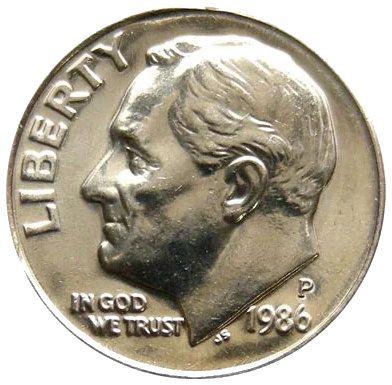
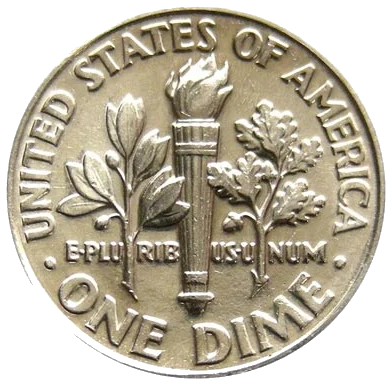
Basics & coin story
The Roosevelt dime introduced in 1946 was designed by John R. Sinnock. By 1986, circulation dimes were clad. The common regular coin gives a baseline for examining the oddities collectors encounter in change.
An error is a fault on an individual coin, such as a blank fed off-center. A doubled die begins in the die and repeats on coins struck from that die. The diagnosis determines which other coins can be useful price comparisons. See the coin error guides for examples grouped by denomination.
| Feature | What to check |
|---|---|
| Mint mark | P on obverse near the date |
| Normal weight / diameter | 2.268 g / 17.9 mm |
| Standard construction | Copper-nickel outer layers over a copper core |
| First photographs | Full faces, straight-on edge and detail with angled light |
Identification
Off-center versus one shifted die
Orient the faces consistently, then look for blank metal and design displacement on both. A thick rim on one side with the reverse centered can result from a misaligned die. Preserve the date and P in the photograph. Heritage lot 21286 is a documented case: it was struck twice, with the second impression about 70% off-center. Look for two distinct impressions before comparing a coin with that lot.
Curved clip versus metal removed later
Check whether the cut follows a plausible arc and whether nearby letters or rim detail taper toward it. Rim weakness opposite the clip, known as the Blakesley effect, can support the diagnosis when present. A rough gouge or sharp saw line points to mechanical damage.
Machine doubling and edge damage
Flat shelf-like steps on a date can be produced at striking without a doubled die. A flattened edge, smeared letters or folded-in reeding can be caused by contact after release. Capture the outline and edge before measuring a suspiciously light coin.
Condition & value
Amounts are in U.S. dollars. Retail guide values are estimates for the stated grade, mint and designation. A dated sale is a record of one coin. Neither is a guaranteed purchase offer.
| Issue | Grade / condition | Value or reference | Basis | Important condition |
|---|---|---|---|---|
| Normal circulation dime | Worn | $0.10 | Face value | P is expected |
| Off-center strike | Authenticated | Match displacement and legible date | Comparable recorded sales | A centered reverse needs another diagnosis |
| Double strike, second strike 70% off-center | PCGS MS62 | $84 in January 2015 | Heritage lot 21286 via PCGS | One sale for this specific double strike |
| Clipped planchet | Authenticated | Match shape, clip size and condition | Comparable recorded sales | Look for strike effects around the gap |
| Missing reverse clad layer | NGC MS64 | Sale amount is not publicly shown | GreatCollections lot 1654726, October 2024 | Check the whole reverse and weight |
| Damage or ordinary strike doubling | Circulated | Usually nominal value | Normal circulation market | No premium inferred from appearance alone |
Summary
Start with the expected P and the ordinary clad weight. Photograph both faces and the rim, then compare only examples that show the same production fault.
Frequently asked questions
Is the P on a 1986 dime an error?
P is the standard Philadelphia mint mark on this issue.
How much should a 1986-P dime weigh?
The standard nominal weight is 2.268 grams.
Does a wide rim prove an off-center strike?
Check for a coherent unstruck area and displacement on both faces. A wide rim alone can have another cause.
Does a doubled date prove a doubled die?
No. Compare rounded design separation and matching markers against a documented attribution.
What is an unusual 1986-P dime worth?
First determine whether it is a normal coin, a damaged coin or a specific mint error. Compare sold examples of the same authenticated error.
References
References and further reading
- USA Coin Book specimen photograph (obverse and reverse)
- PCGS normal 1986-P Roosevelt dime
- Heritage 1986-P double-strike sale, lot 21286, archived by PCGS
- GreatCollections attributed missing reverse clad layer, lot 1654726
- Error-Ref curved clip diagnostics
- Error-Ref centered broadstrikes
- U.S. Mint history of circulating coin designs