

 App Store

COIN VALUE GUIDES · NICKELS
1910 Liberty Head Nickel Value:The V Reverse, Wear and Proofs
Identify a 1910 Liberty V nickel, understand its blank mint-mark field, and compare circulated grades with Philadelphia Proofs.
 HeriBase Editorial TeamPublished
In this article
Quick answer
An ordinary 1910 Liberty Head nickel is a five-cent collector coin with no mint mark. In its circulated guide, PCGS lists $13 at Good 4 and $22 at Very Fine 20 for the regular issue.
Start with the readable date and the portrait and reverse detail. Original Mint State pieces and separately struck Proofs have their own comparisons. The 1910 date has no Denver or San Francisco circulation issue.
Coin photos
Basics & coin story
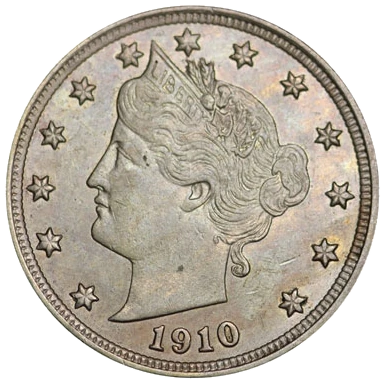
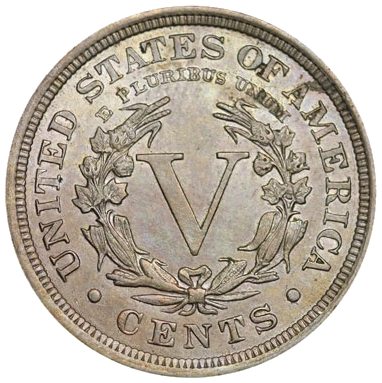
Charles E. Barber’s Liberty nickel uses thirteen stars on the obverse and a large Roman V within the reverse wreath. By 1910, the reverse had long carried the word CENTS beneath the wreath, putting the denomination beyond doubt.
Philadelphia struck 30,166,948 regular coins in 1910 and also made Proofs. The famous first-year No CENTS story applies to one 1883 design. A weak CENTS on a worn 1910 coin is a reason to inspect wear or damage around the bottom rim.
| Feature | What to check |
|---|---|
| Mint | Philadelphia, no mint mark |
| Nominal dimensions | 5.00 g; 21.20 mm |
| Alloy | 75% copper, 25% nickel |
| Reverse denomination | Roman V with CENTS beneath the wreath |
Identification
Inspect the date beside the lowest stars
A dark spot or weak numeral can change the date you read. Use angled light and save a full portrait-side photo. If only the last two digits are visible, compare the remaining design and record the identification as uncertain.
Read both sides for a circulated grade
Look at the letters of LIBERTY in the coronet, Liberty’s hair above the ear and the wheat and leaves in the wreath. Thin rims or partly merged letters can indicate wear. Unusually bright parallel lines can signal a cleaned coin and reduce the usefulness of ordinary grade comparisons.
Compare a claimed Proof with certified pieces
Look for the strike, rim shape and surface finish as a group. A polished business strike can look reflective from some angles. For historical context compare the 1912 Liberty Head nickel guide and check the collector finish against an attributed example.
Condition & value
Amounts are in U.S. dollars. Retail guide values are estimates for the stated grade, mint and designation. A dated sale is a record of one coin. Neither is a guaranteed purchase offer.
| Issue | Grade / condition | Value or reference | Basis | Important condition |
|---|---|---|---|---|
| 1910 circulation strike | Good 4 / Very Fine 20 | $13 / $22 | PCGS retail guide, November 2026 | Match readable date and original surfaces |
| 1910 circulation strike | Mint State | Compare the same numeric grade | PCGS grade guide | Look for natural luster and contact marks |
| 1910 Philadelphia Proof | Certified PR grade | Compare Proof grade and finish | Proof sales | Brightness alone does not establish Proof |
Summary
Identify the date and the V over CENTS, then grade the coronet and wreath together. Use comparable 1910 prices for the same finish and surface quality.
Frequently asked questions
What does V mean on a 1910 nickel?
V is the Roman numeral for five. It identifies the five-cent denomination.
Where is the 1910 nickel mint mark?
The regular 1910 nickel was struck at Philadelphia and has no mint mark.
Does a 1910 nickel contain silver?
No. The normal alloy is 75% copper and 25% nickel.
How much does a worn 1910 nickel fetch?
It depends on condition. The PCGS guide lists $13 at Good 4 and $22 at Very Fine 20 for the regular strike.
Did Philadelphia make a 1910 Proof?
Yes. It is a separate collector issue and should be compared with equivalent Proofs.