

 App Store

COIN VALUE GUIDES · GOLD COINS
Saint-Gaudens Double Eagle:Gold Content, Design Types and Value Checks
Distinguish historic Saint-Gaudens twenty-dollar coins from modern Gold Eagles, compare relief and motto types and calculate a transparent gold-content reference.
 HeriBase TeamPublished
In this article
Quick answer
The historic Saint-Gaudens double eagle is a $20 U.S. gold coin dated within 1907–1933, with standing Liberty and a flying eagle. Standard examples are 90% gold and contain approximately 0.9675 troy ounce of fine gold. They are not one-ounce American Gold Eagles.
Value depends on the exact issue, relief, motto, authenticity and preservation as well as gold. The exceptional 1933 issue must not be used as a routine price comparison for a common-date coin.
Coin photos
Basics & coin story
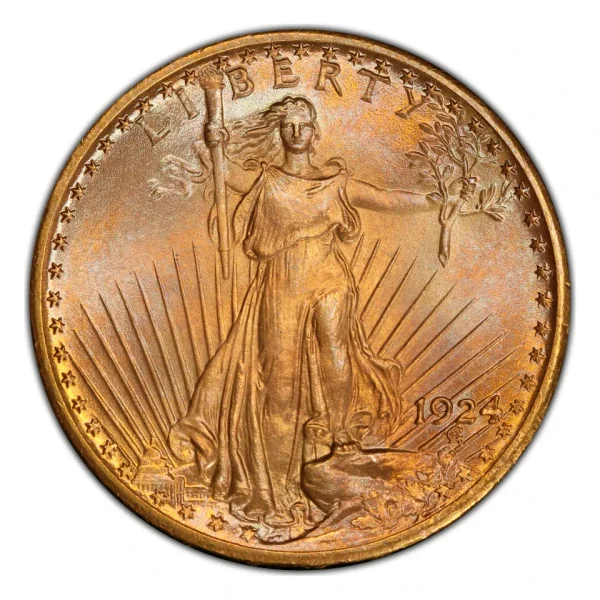
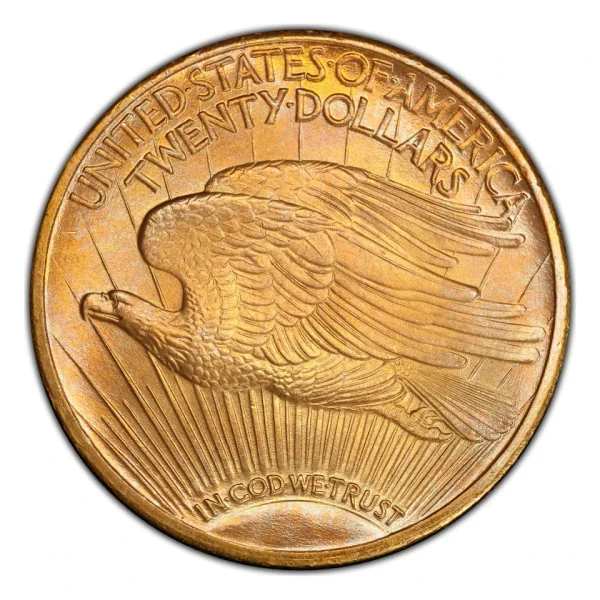
Augustus Saint-Gaudens’s sculpture brought a moving, full-length Liberty to the denomination. Her torch and olive branch give the image its contrasting themes of illumination and peace. The flying eagle continues the sense of motion on the reverse.
The high-relief experiments and production changes of 1907 are important because relief affects how a coin is classified. Later lower-relief coins made the design practical for regular manufacture. A portrait resemblance alone does not establish the early high-relief type.
The double-eagle overview compares Liberty Head and Saint-Gaudens coins. This guide focuses on the latter series; the modern Gold Eagle guide covers a different denomination, alloy and product.
| Feature | What to check |
|---|---|
| Historic denomination | $20 |
| Series date span | 1907–1933; not every date and mint combination exists |
| Standard alloy | 90% gold, 10% copper |
| Nominal fine gold | Approximately 0.9675 troy ounce |
| Typical standard mass / diameter | Approximately 33.4 g / 34 mm |
| Designs | Standing Liberty / flying eagle |
| Type distinctions | Relief, date style and motto |
| Market exception | 1933 requires specialized provenance and legal context |
Identification
Separate the design types
The early 1907 issues include high-relief pieces with Roman numerals and lower-relief production coins with Arabic dates. Do not diagnose relief from one shadowy photograph; use a matching catalog entry and complete views.
No Motto and With Motto reverses are separate types. An absent IN GOD WE TRUST on an appropriate early type is not automatically a mint error. Check the date and exact issue before deciding that lettering is missing.
Calculate metal content without promising a buying price
Multiply approximately 0.9675 by a gold price quoted per troy ounce. This gives a contained-gold reference before market spreads, fees or collector premiums. Do not multiply by the full coin weight as though it were pure gold.
A low price relative to that reference is a reason to investigate identity and terms, not proof of a bargain. A replica, plated object or jewelry-mounted coin may look familiar while belonging to a different market.
Match the exact mint and preservation
Common-date and scarce-mint coins can share the same central picture. Record the date, mint mark, type and grading service before comparing records. Wear, cleaning, edge damage and mounting can materially affect collectibility.
Keep an unverified 1933 separate from normal date sorting. Its history is explained in the 1933 double-eagle guide. Do not assume an object with that date has the status or value of the famous sold specimen.
Condition & value
USD references checked October 29, 2026. Face value is the denomination; a guide estimate is not a completed sale or purchase offer. Where a matched current price was not verified, use the issue-specific comparison described below.
| Issue | Grade / condition | Value or reference | Basis | Important condition |
|---|---|---|---|---|
| Standard genuine coin | Nominal fine gold | 0.9675 × gold price per troy oz | Metal calculation | Excludes premium and fees |
| Common date such as 1924 Philadelphia | Exact grade and original surfaces | Matched collector sales | Issue and condition | Not the 1933 market |
| 1907 high relief | Exact early type | Specialist comparison | Relief and attribution | Not ordinary low relief |
| Damaged or mounted coin | Authenticity established | Compare equivalent impairment | Condition adjustment | Do not use flawless examples |
A melt calculation is useful because its assumptions are visible. It is not a recommendation to melt a collectible coin, and it is not necessarily the amount a buyer will pay. A dealer spread and an auction premium operate differently.
The illustrated 1924 coin demonstrates the standard With Motto design. It does not illustrate every early relief or date-style variation. A grade assigned to another photograph cannot be transferred to your own coin.
Preserve original surfaces and retain receipts, holders and acquisition notes. For a substantial purchase, inspect the actual item and its certification rather than relying only on a familiar-looking design or a copied certificate number.
Summary
Identify the historic $20 coin, its type and exact issue before estimating a premium. Use approximately 0.9675 troy ounce for a transparent gold reference, then compare equivalent preservation and authenticity evidence.
FAQ
Is a Saint-Gaudens double eagle one ounce of gold?
No. A standard historic example contains approximately 0.9675 troy ounce of fine gold.
Is it the same as an American Gold Eagle?
No. The modern Gold Eagle reuses the Liberty design but is a different product and specification.
Does no motto mean an error?
Not on an appropriate early No Motto type. The date and type must be identified together.
Can I use the 1933 auction to value a 1924 coin?
No. The 1933 issue has exceptional provenance and legal history; it is not an ordinary series price benchmark.
References
References and further reading
References consulted October 29, 2026. Price tables retain the update dates stated in the text; guide estimates, face values and completed transactions are different forms of evidence.