

 App Store

COIN VALUE GUIDES · DOLLAR GUIDES
Presidential Dollar Coins:Dates, Checklist and Edge Lettering
Identify Presidential dollars, read the true issue year on the edge, distinguish normal lettering orientation from errors and build a clear collection checklist.
 HeriBase TeamPublished Updated
In this article
Quick answer
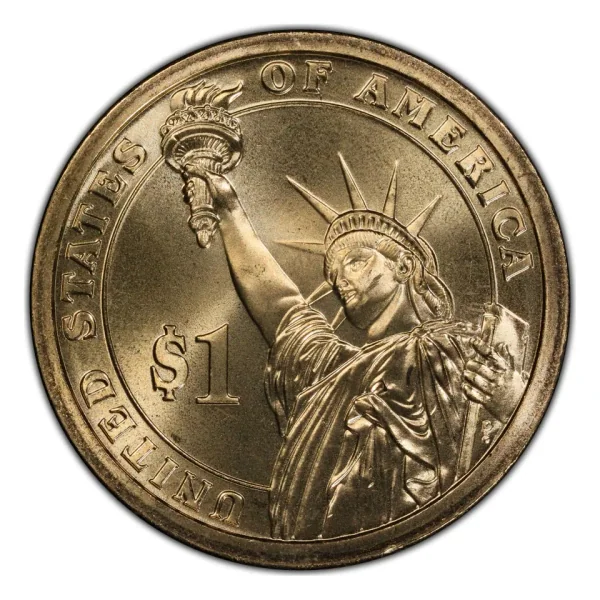
Presidential dollar coins are gold-colored $1 coins featuring presidents on the obverse and the Statue of Liberty on the reverse. They contain no gold. The main program ran from 2007 through 2016, with a George H. W. Bush issue in 2020. Ordinary worn regular strikes generally begin at their one-dollar face value.
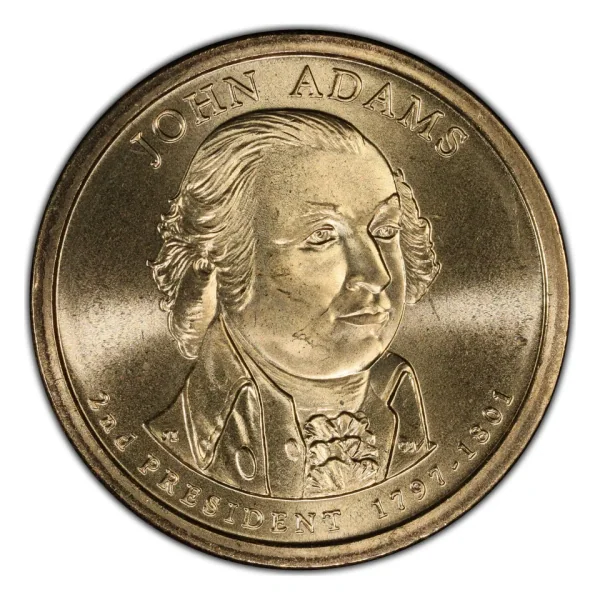
The dates beneath a president’s portrait describe his term, not the year the coin was made. Read the edge for the issue year and mint mark. Upside-down edge lettering on a regular strike is a normal production orientation, not a missing-lettering error.
Coin photos
Basics & coin story
The Presidential $1 program used a changing portrait and a common Liberty reverse to place presidential history on spendable dollar coins. The sequence follows service in office; Grover Cleveland has two separate issues because he served nonconsecutive terms.
The series does not supply a coin for every living president at the time of the program. Its eligibility rule and issue sequence differ from a classroom list of officeholders. Production for general circulation was suspended after 2011, while collector distribution continued.
Moving legends to the edge left more room for portrait art. That decision also created a practical identification problem: a photograph of the two faces can omit the true issue date. Preserve edge information when sorting or listing these coins.
| Feature | What to check |
|---|---|
| Denomination / alloy | 1 dollar / manganese-brass clad copper; no gold |
| Nominal mass / diameter | 8.1 g / approximately 26.5 mm |
| Main program | 2007–2016; George H. W. Bush in 2020 |
| Common reverse | Statue of Liberty / $1 |
| Regular mint identities | P Philadelphia and D Denver |
| Proof mint | S San Francisco |
| Issue year and mint | Edge inscriptions |
| Obverse term dates | Presidential service dates; not the minting date |
For the broader distinction between golden change and coins containing gold, see gold dollar coin value: modern $1 coins versus real gold dollars. Do not apply a nineteenth-century gold-dollar price to a normal Presidential dollar.
Identification
| Issue year | Portraits |
|---|---|
| 2007 | Washington, John Adams, Jefferson, Madison |
| 2008 | Monroe, John Quincy Adams, Jackson, Van Buren |
| 2009 | William Henry Harrison, Tyler, Polk, Taylor |
| 2010 | Fillmore, Pierce, Buchanan, Lincoln |
| 2011 | Andrew Johnson, Grant, Hayes, Garfield |
| 2012 | Arthur, Cleveland (first term), Benjamin Harrison, Cleveland (second term) |
| 2013 | McKinley, Theodore Roosevelt, Taft, Wilson |
| 2014 | Harding, Coolidge, Hoover, Franklin D. Roosevelt |
| 2015 | Truman, Eisenhower, Kennedy, Lyndon B. Johnson |
| 2016 | Nixon, Ford, Reagan |
| 2020 | George H. W. Bush |
Read the edge, not just the term
For John Adams, 1797–1801 identifies his presidential term; the coin’s 2007 issue date is on the edge. For Martin Van Buren, the term 1837–1841 is likewise different from the 2008 issue. Their Adams guide and Van Buren guide provide issue-specific comparisons.
IN GOD WE TRUST appears on the edge for 2007–2008 issues and moved to the obverse from 2009. A later coin lacking that phrase on the edge can therefore be completely normal.
Treat orientation as normal on regular strikes
The edge inscriptions are applied in a separate operation to regular strikes, with random orientation relative to the portrait. Both directions are expected. Position A or B catalog labels do not automatically imply a scarce error.
Proof coins use a different production process with an edge-lettered collar. Do not apply a regular-strike orientation explanation as proof that every possible Proof edge feature is normal or erroneous.
Check claimed missing lettering for alteration
A genuine omission is different from a ground-down or filed edge. Examine the whole circumference, diameter and surface texture; partial wear or one unreadable section is not proof of a completely omitted production step.
NGC has documented altered Washington dollars made to resemble missing-edge-lettering pieces. If an error premium is the central reason to buy, obtain suitable authentication rather than relying on a seller’s photograph of one smooth segment.
Condition & value
USD references checked October 28, 2026. Face value is a denomination, not an estimate for every collector version. No unsupported current retail price is assigned to a special grade or unverified error.
| Issue | Grade / condition | Value or reference | Basis | Important condition |
|---|---|---|---|---|
| Ordinary worn regular dollar | Correct date and normal edge | $1 baseline | Face value | Gold color is not gold |
| Collector regular or satin issue | Exact product, year and grade | Use matched sales | Collector market | Do not mix finishes |
| S Proof | Proof grade and contrast | Separate Proof entry | Collector manufacture | Not established by shine |
| Normal A/B edge orientation | Regular-strike production | No error premium assumed | Expected orientations | Match any collectible designation |
| Missing-edge claim | Authenticated omission | Case-specific | Attribution required | Altered edges exist |
Define a set before comparing totals. One coin for each issued portrait is a different collection from a complete P-and-D group, a Proof series or every satin-finish issue. A mixed album’s retail price may include its presentation and assembly cost.
Keep manufacture and numerical grade together. A certified high-grade dollar with an attribution is not a pricing reference for a worn example with the same president. For collector-distributed later dates, absence from ordinary change does not by itself establish exceptional rarity.
Do not clean or polish the brass-colored surface. Photograph the portrait, Liberty reverse and the entire edge in a sequence. The complete record makes it easier to distinguish an issue identification question from an error attribution.
For a detailed edge comparison, see John Adams doubled edge lettering versus normal Position A/B, with real same-direction and opposite-direction inscription photographs.
Summary
Read the president, edge year, mint and manufacture before choosing a comparison. Gold color is expected and random lettering orientation on regular strikes is normal. Build a defined checklist and authenticate genuine edge-omission candidates before assigning a premium.
FAQ
Do Presidential dollars contain gold?
No. Their gold-colored manganese-brass clad construction is not gold bullion.
Where is the year on a Presidential dollar?
The issue year is on the edge. Dates beneath the portrait describe the president’s term.
Is upside-down edge lettering an error?
On ordinary regular strikes either orientation is normal because lettering is applied in a separate operation.
Why are there two Grover Cleveland dollars?
The program recognizes his two nonconsecutive presidential terms with separate issues.
References
References and further reading
- U.S. Mint: modern dollar programs
- U.S. Mint: edge-lettering production
- PCGS: normal edge orientation
- NGC: altered missing-edge claims
References consulted October 28, 2026. Price tables retain the update dates stated in the text; guide estimates, face values and completed transactions are different forms of evidence.